How much protein does a woman in her forties actually need?
The short version: most active women in their forties do well on roughly 1.2 to 1.6 grams of protein per kilogram of body weight a day, which is more than the official minimum, spread across your meals, and paired with lifting weights. The exact number is debated. The direction is not. Most of us eat too little, and it is muscle we will want later.
I am not a dietitian, and this is not a prescription. It is how I have worked it out for my own body, from reading the research and from talking to people I trust, including my old personal trainer, then coming to my own conclusion. I am still learning, and I will tell you where the evidence is solid and where it is still argued over.
Why protein starts to matter more in your forties
From our mid-thirties we slowly lose muscle, and it speeds up in midlife as oestrogen falls. Muscle is not a vanity project. It is what keeps you strong, steady on your feet and metabolically well into old age, and it is far harder to rebuild than to keep. Protein is the raw material your body uses to hold on to it, and lifting weights is what tells your body to actually do it. The two belong together, which is why I treat protein and strength training as one subject rather than two. I go deeper on the training itself in a separate piece.
What do I mean by active?
This matters, so it is worth clearing up. When the research talks about needing more protein, active does not mean simply being on your feet or getting your steps in. A daily walk is good for you, but it is not the same signal to your muscles as lifting something heavy. The higher protein targets are for women doing resistance training, weights, bands or hard bodyweight work, two or three times a week. If that is you, the numbers below apply. If you are not lifting yet, the most useful thing you can do is start, and let the protein follow it.
What the official number is, and why it is a floor, not a target
The official recommendation, around 0.8 grams of protein per kilogram of body weight a day, gets quoted as if it were the goal. It is not. That figure is the minimum set so a sedentary adult does not become deficient. It was never meant to describe what a woman in her forties needs to hold on to muscle, especially one who trains. Treating the floor as the ceiling is where a lot of us quietly fall short without realising.
So what should you actually aim for?
The honest answer is a range, not a number, and where you land in it depends on how hard you train. The expert groups who study protein in older adults, PROT-AGE and ESPEN, put the floor for us at 1.0 to 1.2 grams per kilogram a day, rising above 1.2 for those who are active. Sports-nutrition bodies looking at women who train seriously go higher, up to around 2.0 to 2.2 grams. For a woman lifting two or three times a week, not chasing maximum muscle, somewhere around 1.2 to 1.6 grams per kilogram is a sensible target. For a 65 kilogram woman that is roughly 80 to 105 grams a day, which is still more than most of us eat without paying attention.
You will see it insisted, usually by someone selling a protein powder, that everyone needs a gram per pound of body weight, near 2.2 grams per kilogram. For a woman training hard for muscle, that is genuinely within the evidence. For most of us lifting a couple of times a week it is more than we need and more than is easy to eat, so do not feel you have failed if you are nowhere near it. The point almost everyone needs to hear is the opposite one, and it is well documented: post-menopausal women eat markedly less protein than younger women, often barely at the minimum. So the real headline is not to hit the maximum, it is that you almost certainly need to eat more than you do.
Collagen supplements often get sold as a protein source too. They're not much of one.
It is not only how much, it is when
Your body can only use so much protein for muscle at once, so one big hit at dinner does less than the same amount spread out. A proper serving at each meal, very roughly 25 to 35 grams, does more than a token breakfast and a huge evening plate. This is where most of us lose it, not at dinner, but at a nearly protein-free breakfast and lunch. Fixing breakfast alone often closes most of the gap, which is why I am putting together a short set of protein-rich breakfasts you can actually be bothered to make. And while everyone is shouting about protein, do not forget fibre, which matters just as much and gets almost none of the attention. I will come to fibre on its own.
A day of it on my plate
This is roughly what I eat at the moment, and I am adjusting it as I go, so take it as a picture rather than a plan. Breakfast is usually three eggs, scrambled, boiled or fried in a little organic butter, with a quarter of an avocado and some leafy greens. Other mornings it is Greek yoghurt with a spoon of ground organic flax, a few sunflower seeds and some blueberries or strawberries.
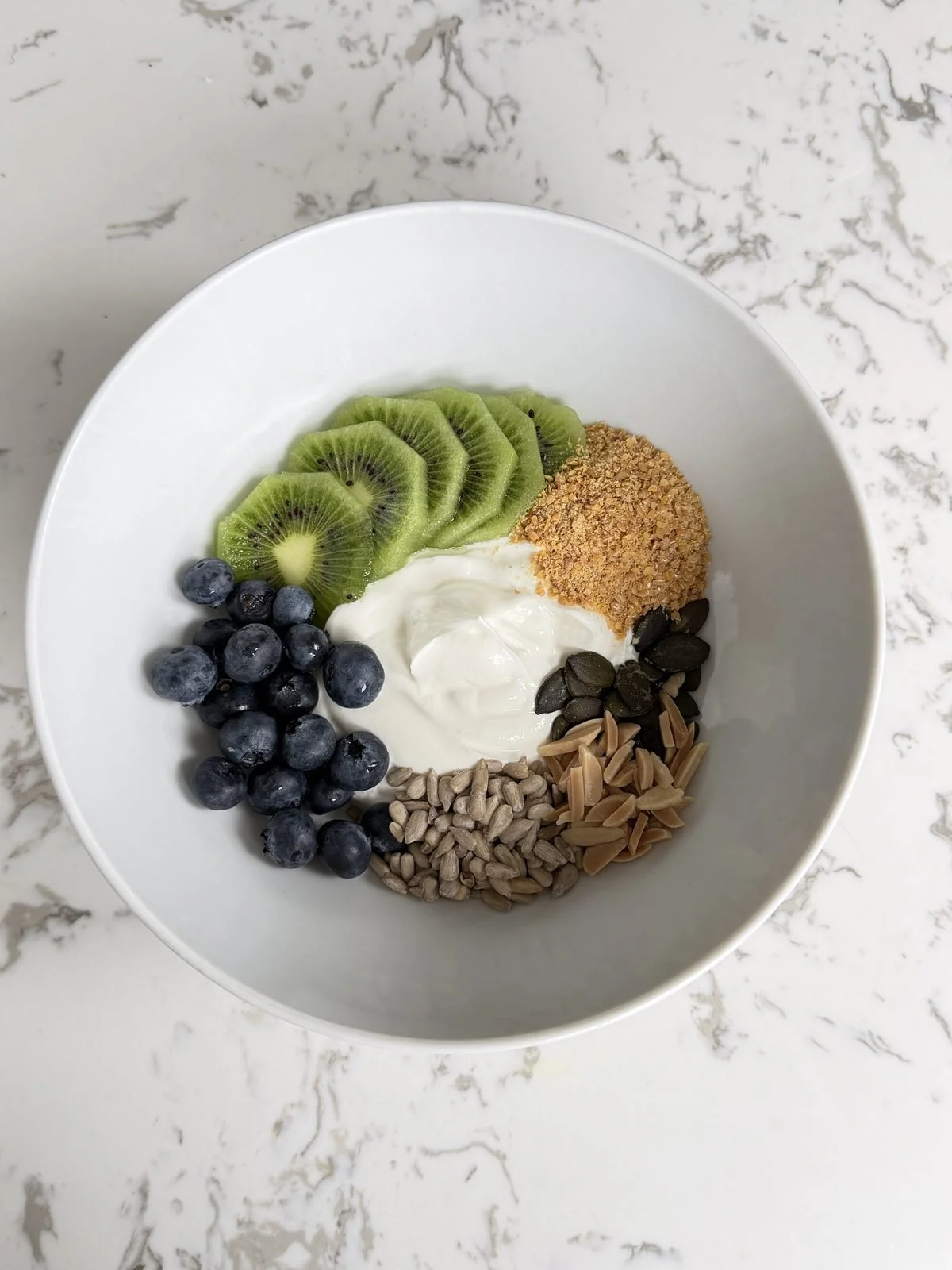
My protein-forward breakfast bowl: Greek yoghurt, seeds, nuts and fruit.
Lunch in the summer is a lighter thing: a salad with tuna or chicken, some cooked vegetables in olive oil, a little quinoa, and sometimes toasted nuts and seeds.
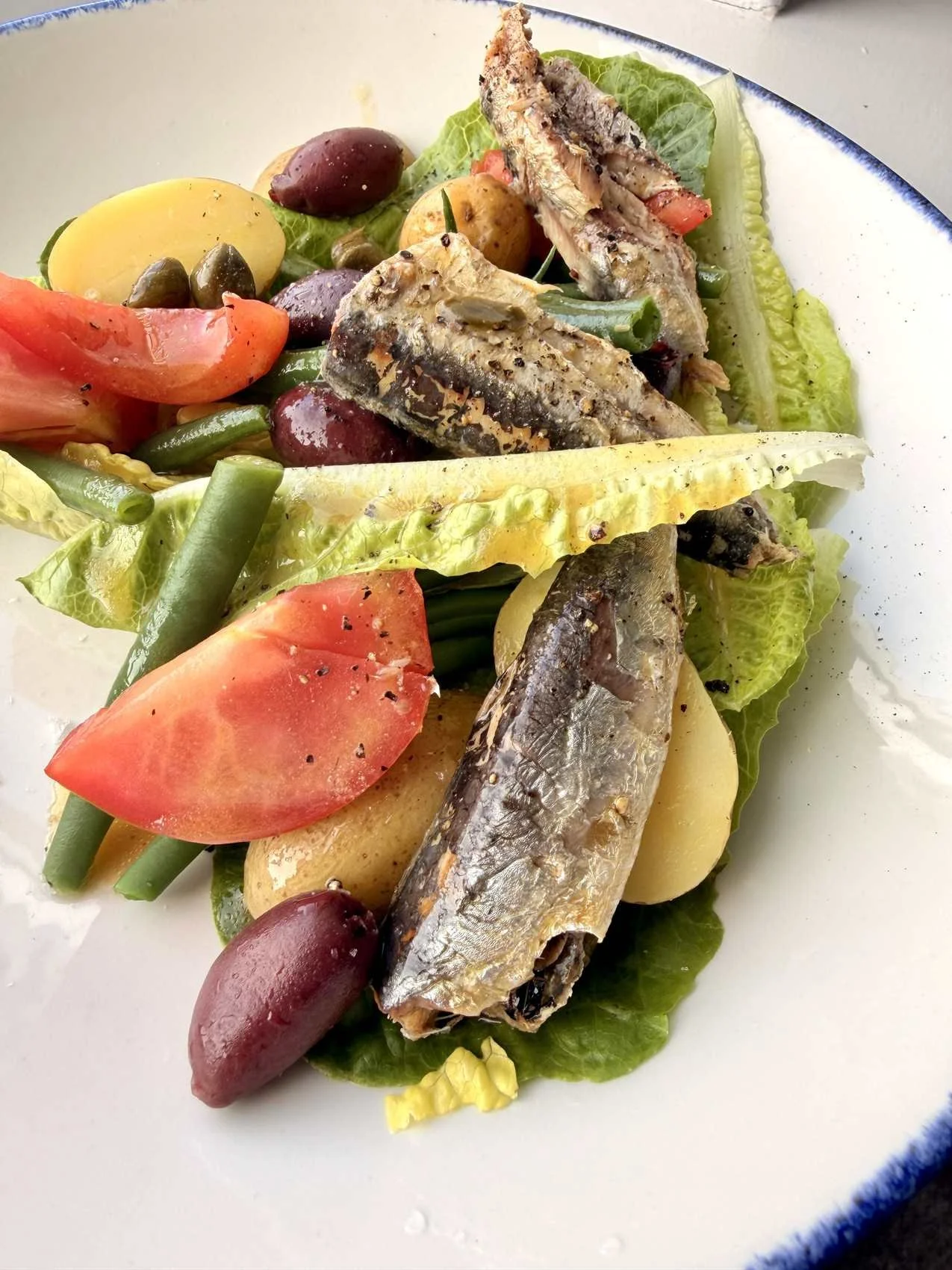
Summer lunch, a Niçoise with sardines instead of tuna.
Dinner always has fish, poultry or meat at the centre of the plate rather than as an afterthought. In winter I lean on stews. In the hot months it is more like Lebanese-inspired kofta or a piece of pan-fried or grilled fish, with a salad, and maybe courgettes I par-boil and finish with olive oil, lemon, salt and pepper. Simple, and very Mediterranean.
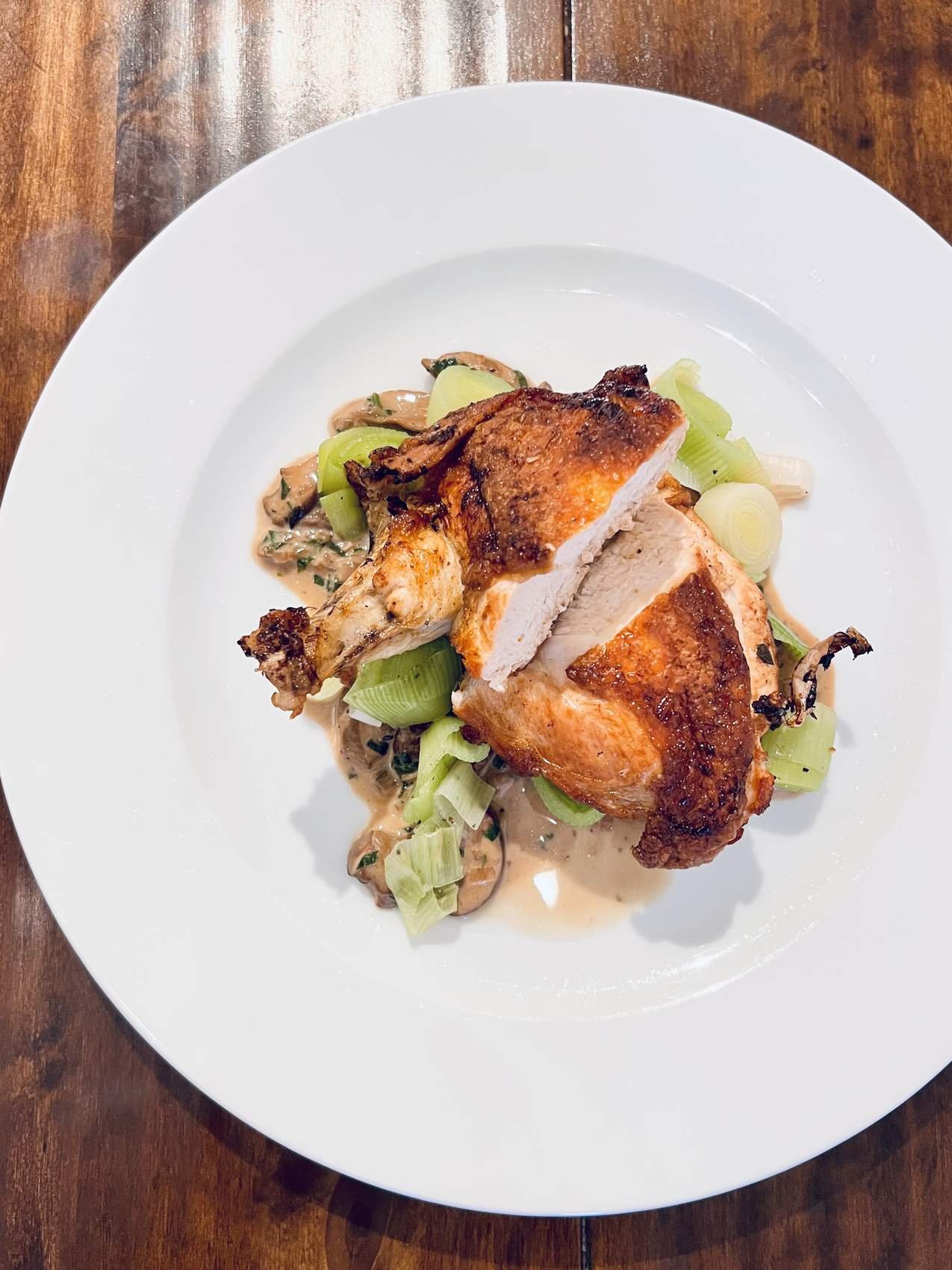
Dinner, pan-roasted chicken breast over mushroom and leek cream.
I do not weigh anything generally. I just make sure protein is the thing I build each meal around, and it adds up without a spreadsheet.
A couple of caveats
Two things worth being clear about. If you have reduced kidney function or another medical condition, the general advice here does not automatically apply to you, and that is a conversation for your doctor, not a blog. And the exact optimal number will keep being argued over, so do not treat any single figure, mine included, as settled. The other half of this, and the way I have come at my own health, is to actually listen to your body. When things did not feel right for me, I went and had blood tests rather than guessing. If something feels genuinely wrong, see someone. But if nothing serious is the matter, there is a lot to be said for changing one thing at a time and simply noticing: do you have more energy, do you feel stronger, do you sleep better. Your own experience, watched carefully over a few weeks, will tell you more than any single number. What does a normal breakfast look like for you, and is there any protein in it?
If this was useful, my newsletter is where I go deeper into food, the body and what is actually worth it, one considered piece at a time. You can join below.
Related reading: Do collagen supplements actually work?
Sources
Bauer J and others. Evidence-based recommendations for optimal dietary protein intake in older people, a position paper from the PROT-AGE Study Group. Journal of the American Medical Directors Association, 2013. sciencedirect.com/science/article/pii/S1525861013003265
Protein recommendations for supporting muscle and bone health in older adults, a mini review. Frontiers in Nutrition, 2024.frontiersin.org/journals/nutrition/articles/10.3389/fnut.2024.1394916/full
Inadequacy of protein intake in older UK adults, drawing on the National Diet and Nutrition Survey. 2020. ncbi.nlm.nih.gov/pmc/articles/PMC7151458/
The impact of protein in post-menopausal women on muscle mass and strength, a narrative review. 2024. mdpi.com/2673-9488/4/3/16
International Society of Sports Nutrition, position stand on protein and exercise, including intake ranges and per-meal distribution for active women.